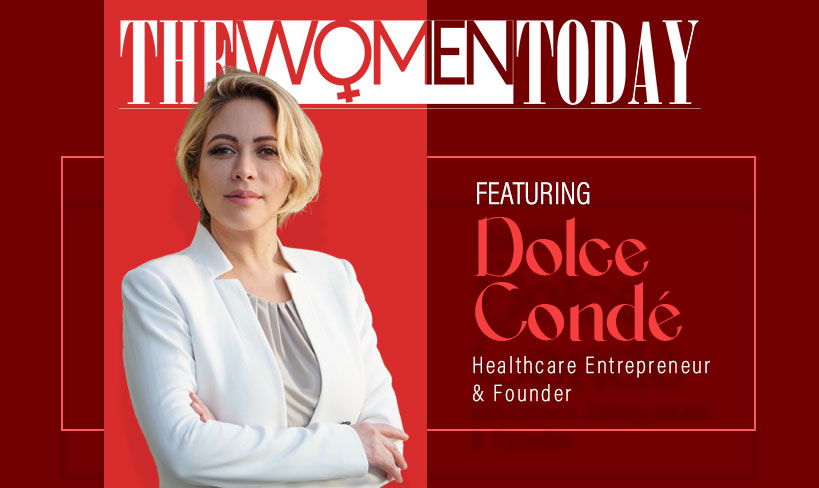
Dolce Condé is a healthcare entrepreneur with more than 20 years of experience building and leading healthcare organizations. As Founder of Ruzena Health and Founder & CEO of EBienLabs, her work increasingly focuses on a question facing today’s organizations: what happens when employee health is treated not simply as a benefit, but as a component of business performance?
Through Ruzena Health, Dolce is developing a more strategic approach to corporate health, connecting evidence-based health strategies, measurable insights, education and personalization to help organizations build healthier, more resilient and higher-performing teams.
The Healthcare Journey
We started the interview by asking, “Dolce, you have more than 20 years of experience across healthcare and business. What initially attracted you to the healthcare industry?”
Dolce Condé replied, “Healthcare was part of my world long before it became my career. I grew up in a family where healthcare was very present, so conversations about health, medicine, and caring for others were part of my environment from an early age.
As I built my own career, I became fascinated by how healthcare brings together business, science, technology, and, most importantly, human impact.
My career has allowed me to experience healthcare from very different perspectives, from business development and strategic partnerships to healthcare operations, long-term care, laboratory services, and executive leadership. Each of those experiences taught me something different about how health affects not only individuals, but also families, organizations, and communities.”
From Healthcare Services to Precision
The Women Today: How has your perspective on healthcare evolved over the course of your career?
Dolce Condé replied, “One of the things my years in healthcare have taught me is how much of our system is designed around what happens after something goes wrong. We have become incredibly sophisticated at diagnosing and treating disease, but I believe there is an enormous opportunity to help people understand and manage their health earlier, with the goal of preventing or delaying the need to become a patient in the first place.
Technology is making that increasingly possible. We now have access to more health information than ever before, and AI is creating new possibilities for identifying patterns, interpreting data, and making health insights more personalized and actionable.
That is probably where my perspective has changed the most. Today, I am much more interested in what we can do before disease or crisis occurs, rather than only what we can do afterward.
I believe the future of healthcare will increasingly move toward being more predictive, preventive, and personalized, and that’s the direction that interests me most today.”
Healthcare Entrepreneur
The Women Today: How would you describe your professional identity today?
Dolce Condé replied, “First and foremost, I consider myself a healthcare entrepreneur.
I’ve spent much of my career identifying problems within healthcare and finding ways to bring together people, organizations, information, and resources to solve them.
Today, I’m particularly interested in the intersection between health and human performance. We often talk about health as something separate from the rest of our lives, but our physical and mental state affects how we think, lead, communicate, make decisions, and perform.
That relationship between health and performance is becoming increasingly important to the work I’m building today.”
Health and Performance
The Women Today: After two decades in healthcare, what led you to focus on the relationship between employee health and business performance?
Dolce Condé replied, “I began looking at the way companies invest in performance based on my own experience.
As organizations, we invest significantly in technology, leadership development, training, culture, recruitment, and productivity. Yet the health of the people responsible for producing those results is often addressed primarily through benefits or isolated wellness initiatives.
Even after spending most of my career in healthcare, there were periods when I was so focused on my businesses and responsibilities that my own health became secondary. And I could see the difference. When I wasn’t sleeping well, managing stress, exercising, or taking care of myself properly, my energy, focus, and ultimately my performance were affected. It made something very clear to me: professional performance and personal health are not separate.
Employee health is certainly not solely the employer’s responsibility. But if we want to build stronger organizations and support people in performing at their best, I believe companies should invest in creating environments and providing resources that make it easier for employees to take care of their health.”
Personalizing Wellness
The Women Today: Why do you think some traditional corporate wellness programs struggle to create meaningful engagement?
Dolce Condé replied, “I don’t think the problem is necessarily that traditional wellness programs are ineffective. Many have done important work.
The challenge is that health is deeply personal.
Two employees working for the same company may have completely different health priorities, stressors, lifestyles, motivations, and needs. Giving everyone the same information or resources doesn’t necessarily create the same value for everyone.
I believe personalization can make corporate health more relevant. When people understand why something matters specifically to them, they are more likely to engage with it.
The future, in my view, is not simply offering more wellness resources. It’s making those resources more meaningful to the individual.”
The Ruzena Vision
The Women Today: You have initially positioned Ruzena around beauty, fashion, and lifestyle companies. Why are those industries particularly interesting to you?
Dolce Condé replied, “I’m drawn to companies whose brands are built around aspiration, identity, experience, and how people feel.
Beauty, fashion, and lifestyle companies invest tremendous thought into understanding their consumers and creating experiences that reflect their brand values.
I think there is an interesting opportunity for the internal employee experience to receive that same level of intentionality.
The strongest brands aren’t only what customers see externally. They’re also shaped by the people behind them.
Helping those organizations create a healthier, more resilient, and higher-performing internal culture feels very aligned with what their brands already represent.”
The Power of Health Data
The Women Today: Your background includes diagnostics and laboratory medicine. How does that influence your perspective on corporate health?
Dolce Condé replied, “It taught me the value of information.
We often make decisions about health based on how we feel, but biological information can sometimes reveal a much more nuanced picture.
At the same time, more data isn’t automatically better. Data becomes valuable when people understand what it means and can use it appropriately.
My experience in diagnostics has made me particularly interested in how health information can become more accessible and, more importantly, actionable. That perspective naturally influences how I think about personalization and measurement within corporate health.”
Women and Wellbeing
The Women Today: As a publication focused on women, we’re particularly interested in your perspective on women in leadership. Do high-achieving women face unique challenges in protecting their health?
Dolce Condé replied, “I think many high achieving women become exceptionally good at carrying responsibility.
They may simultaneously be leading organizations, managing teams, raising families, caring for parents, maintaining relationships, and holding themselves to very high personal standards.
The danger is that their own health can become something they intend to address later.
And sometimes the external signs of success can hide the internal cost of maintaining that pace.
I believe one of the important conversations for women in leadership is moving health from something we address when something goes wrong to something we actively protect while we’re building our careers and our lives.
I believe wellbeing should be one of the ways we measure success.”
Lessons from Hospice
The Women Today: You spent many years leading a hospice agency. How did that experience influence your perspective on health?
Dolce Condé replied, “Hospice profoundly influenced how I think about healthcare because it puts quality of life into a very clear perspective.
It reminds you that healthcare isn’t ultimately about technology, diagnostics, or commercial growth. It’s about people, families, dignity, relationships, and the quality of the time we have.
That experience strengthened my interest in prevention and longevity, but also changed what longevity means to me.
Living longer is valuable only if we are also protecting our ability to live those years with health, independence, purpose, and quality of life.
It also reinforced something I’ve carried throughout my career: health rarely affects only one person. It affects families, relationships, workplaces, and communities.”
Leadership Lessons
The Women Today: You have built and led businesses across different areas of healthcare. What has entrepreneurship taught you about leadership?
Dolce Condé replied, “Some of my most important lessons about leadership were learned the hard way.
I’ve learned the importance of boundaries and of trusting myself when I know something isn’t right. There have been times in my career when I knew the answer should have been “no,” but I said “yes” anyway because I didn’t want to disappoint someone, create conflict, or close a door. Some of those decisions came with a significant cost, both personally and professionally.
I’ve learned that not setting a boundary is still a decision, and eventually you pay for it somewhere.
Leadership requires continuous adaptation. Businesses change, markets change, people change. The strategy that worked at one stage may not be the strategy required for the next.
Leadership is not about having every answer. It’s about asking better questions, surrounding yourself with capable people, and then, being willing to make difficult decisions, even when they are uncomfortable or unpopular.”
Rethinking Success
The Women Today: What advice would you give other women building businesses or leading organizations?
Dolce Condé replied, “Don’t confuse endurance with effectiveness.
Women can become very good at handling enormous amounts of responsibility, and sometimes we wear that capacity almost as a badge of honor.
But being able to sustain an unhealthy pace doesn’t necessarily mean that pace is helping us perform at our highest level.
Protecting your health, creating boundaries, asking for help, delegating, and building systems around yourself are not signs of reduced ambition. They can actually make sustained ambition possible.
I think we need to redefine high performance so that it includes the person doing the performing.”
The Next Chapter
Lastly we asked, “Looking ahead, what is your vision for the next chapter of your work?”
“At this stage of my career, I’m less interested in defining the next chapter by one company or one project. I’ve built businesses in very different areas of healthcare, and I’ve realized that there is a common thread behind much of what I do: I’m fascinated by how we can help people understand their health earlier, make better decisions, and ultimately live better.
I also think my definition of success has evolved. Earlier in my career, I measured success primarily by growth, building companies, creating opportunities, reaching the next milestone. I still love building businesses, and I don’t think that will ever change, but today I care much more about what I am building, why I am building it, and the impact it can have.
Whether I’m working in diagnostics, preventive health, longevity, or developing new ways for organizations to support their people, I want my work to contribute to moving healthcare further upstream, before disease, before crisis, and ideally before someone needs to become a patient.
Personally, I also want this next chapter to reflect some of the lessons I’ve learned along the way: to be ambitious without sacrificing myself in the process, to be more intentional about where I invest my time and energy, and to build things that genuinely matter to me.
I still have a lot I want to build. I just have a much clearer understanding today of what I want that success to look like.” Dolce Condé concluded
Connect with Dolce Condé on LinkedIn
For more information visit Ruzena health
Also Read:-
Sofica Bistriceanu on Ethics, Trust & Human Transactions
IXI CX Agency improves business performance – Helen Risovets
Inside the Mind: Kimberly Golld Beauty & Lingerie Journey!