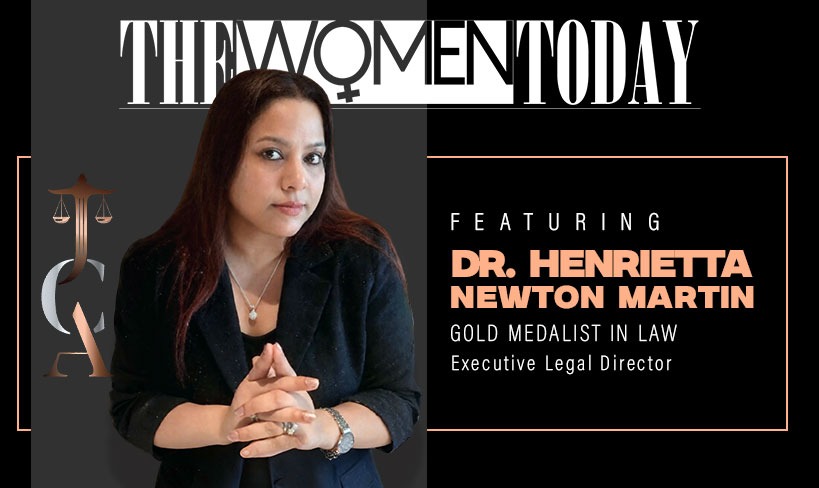
Dr. Henrietta Newton Martin is a Gold Medalist in Law, Legal & Policy Strategist, Post-Doctoral Research Scholar, and Fellow in Education and International Law, with specialised research interests spanning Artificial Intelligence, Business Psychology, and International Law. Her professional expertise encompasses AI law, corporate diplomacy, governance, cross-border intelligence, corporate and commercial law, strategic contracting, international transactions, compliance, dispute resolution, ESG, and legal risk management. Working at the intersection of law, technology, policy, and business strategy, she brings an interdisciplinary perspective to complex legal and organisational challenges. As Legal Director at JusCogen & Alcop LLC, Dr. Henrietta Newton Martin leads legal operations, strategic planning, compliance, contracting, and risk management, while supporting organisations in navigating emerging AI regulations and complex international business environments.
Her academic contribution extends across teaching, thesis supervision, legal scholarship, post-doctoral research, and international speaking engagements, with a focus on law, governance, diplomacy, education, and strategic management. Her work reflects a broader commitment to connecting rigorous academic thought with practical professional leadership and meaningful societal impact.
Building Legal Strategy for Business
We started the interview by asking, “Dr. Henrietta Newton Martin can you please introduce yourself, and what areas of law and business strategy do you specialize in?”
Dr. Henrietta Newton Martin replied, “I am a Legal & Policy Strategist focused on helping organizations navigate complex legal, regulatory, and commercial environments. My work brings together corporate and commercial law, governance, strategic contracting, cross-border transactions, dispute resolution, compliance, ESG, and risk management.
Increasingly, my work also focuses on AI law and technology regulation. I believe legal strategy should not operate separately from business strategy. Effective legal advice should help organizations make better decisions, manage risk, control costs, and create sustainable commercial value.”
Shaping Responsible AI Regulation
The Women Today: What is the role of AI law in shaping the future of technology regulation?
Dr. Henrietta Newton Martin replied, “AI law is becoming a critical component of responsible technology development. As artificial intelligence becomes integrated into business operations, organizations need governance frameworks that address accountability, transparency, data protection, intellectual property, risk, ethics, and regulatory compliance. The challenge is to create frameworks that protect stakeholders without unnecessarily restricting innovation. My approach is to help organizations understand emerging regulatory requirements and translate them into practical governance, compliance, and risk-management systems that can operate across jurisdictions.”
Turning Legal Strategy into Business Value
The Women Today: How does legal strategy contribute to cost optimization and business growth?
Dr. Henrietta Newton Martin replied, “Legal strategy can significantly influence business costs when it is integrated into decision-making from the beginning. Many organizations incur unnecessary expenses because legal risks are identified too late, contracts are poorly structured, compliance processes are duplicated, or disputes are allowed to escalate. A strategic legal function should identify potential risks early, simplify processes, strengthen contractual protections, and create scalable compliance frameworks. The objective is not merely to prevent problems but to design legal structures that support efficient operations, sustainable growth, and measurable business value.”
Cross-Border Transactions
The Women Today: What are the most important considerations when structuring cross-border transactions?
Dr. Henrietta Newton Martin replied, “Cross-border transactions require much more than reviewing a contract. Organizations need to consider jurisdiction, applicable law, taxation, regulatory requirements, corporate structures, dispute-resolution mechanisms, sanctions and trade restrictions, intellectual property, data protection, and enforcement risks. Cultural and commercial considerations are equally important. A transaction can be legally sound but commercially ineffective if the parties do not understand the business environment in which the agreement will operate. Cross-border intelligence therefore plays an important role in designing transactions that are both legally robust and commercially viable.”
Making Contracts Work for Business
The Women Today: What is your approach to strategic contracting and high-value agreements?
Dr. Henrietta Newton Martin replied, “A contract should be viewed as a business instrument, not simply a legal document. Before drafting or negotiating an agreement, I focus on understanding the commercial objectives, potential risks, responsibilities of each party, and the long-term relationship.
For high-value agreements, joint ventures, partnerships, and international transactions, I focus on creating clarity around obligations, governance, performance, liability, intellectual property, termination, dispute resolution, and exit mechanisms. Good contracting should protect the organization while preserving opportunities for collaboration and growth.”
From Knowledge to Purpose
The Women Today: Beyond your professional achievements in academia and law, you place considerable emphasis, and restoring dignity to people facing difficult circumstances. What does “giving back” mean to you personally?
Dr. Henrietta Newton Martin replied, “Academia has always constituted an important dimension of my professional trajectory. As an academician and adjunct faculty associated with prominent international institutions, I have had the privilege of engaging with students, emerging scholars and professionals across diverse jurisdictions. I regard teaching not merely as the dissemination of knowledge, but as an intellectually enriching endeavour through which one can cultivate critical inquiry, epistemic rigour, ethical discernment and an appreciation of law as a consequential instrument of societal transformation.
Mentorship is equally intrinsic to my professional ethos. I mentor contemporary professionals with the conviction that experience acquires greater significance when it is shared. I endeavour to encourage young professionals to transcend the confines of conventional thinking, develop intellectual independence and cultivate the confidence to articulate their own professional identity. Mentorship, in my view, is not a hierarchical transaction but a dialectical exchange of knowledge, experience and perspective, wherein the mentor also continues to learn. My engagement, however, extends beyond academia and the legal profession. I am deeply inclined towards social causes that concern human dignity, restoration and empowerment. I feel particularly strongly about supporting women who have endured profoundly difficult circumstances, including survivors of sexual violence, unwed mothers and women who, through circumstances beyond their control, have experienced a profound erosion of purpose, confidence or social belonging. I believe that society must move beyond judgement and towards rehabilitation, agency and substantive empowerment. A person’s most difficult chapter should never be permitted to become the definitive narrative of her life.
I am similarly passionate about causes concerning the elderly and those residing in old age homes. There is a quiet poignancy in recognising that individuals who once devoted their lives to families, professions and communities can eventually find themselves confronting loneliness or social invisibility. Their dignity must remain ineluctable, irrespective of age, circumstance or social circumstance.
Giving Back is The Privilege of my Purpose in life
I believe that giving back to society is not merely a charitable impulse; it is a moral corollary of privilege, opportunity and achievement. Whatever knowledge, influence or opportunities we acquire should ultimately transcend the individual and acquire a larger social purpose.
For me, true success is therefore not entirely encapsulated by professional accomplishments. It is equally reflected in the lives we have touched, the confidence we have restored, the dignity we have protected and the hope we have rekindled. My message is simple, although its implications are profound: we are truly human when we learn to care deeply and respect unconditionally.
In an increasingly transactional world, compassion is perhaps the most sophisticated expression of humanity. To care without condescension, to respect without distinction and to extend support without seeking recognition is, to my mind, the most authentic form of giving back.
Ultimately, our legacy should not be measured solely by what we accumulated, but by what we ameliorated, whom we empowered and how much humanity we left behind us.”
International Dispute Resolution
The Women Today: How do you approach complex cross-border disputes and international dispute resolution?
Dr. Henrietta Newton Martin replied, “Complex disputes require a combination of legal analysis, commercial judgment, and strategic decision-making. Litigation is not always the best solution. Depending on the circumstances, arbitration, mediation, negotiation, or other forms of alternative dispute resolution may provide a more efficient outcome. My approach is to understand the commercial objective first, assess the legal position and available remedies, and then determine the most appropriate strategy. The goal is to resolve disputes efficiently while protecting the organization’s long-term interests.”
ESG & Corporate Governance
The Women Today: How can ESG principles be integrated into corporate legal and governance frameworks?
Dr. Henrietta Newton Martin replied, “ESG should be integrated into governance rather than treated as a separate corporate initiative. Legal teams can play an important role by embedding ESG considerations into policies, contracts, supply-chain arrangements, risk controls, reporting frameworks, and board-level decision-making.
Organizations should understand not only their environmental and social commitments but also the legal and reputational consequences of failing to meet them. Strong ESG governance can improve resilience, stakeholder confidence, and long-term corporate sustainability.”
Corporate Diplomacy
The Women Today: What does effective corporate diplomacy mean in today’s international business environment?
Dr. Henrietta Newton Martin replied, “Corporate diplomacy is about managing relationships and interests across different stakeholders, jurisdictions, cultures, and regulatory environments. International businesses often need to engage with governments, regulators, investors, partners, employees, communities, and other institutions.
Legal knowledge provides the foundation, but effective corporate diplomacy also requires cultural intelligence, strategic communication, negotiation skills, and an understanding of geopolitical and commercial realities. This combination can help organizations build trust and navigate complex international environments.”
Innovation, Compliance & Ethics
The Women Today: What are the biggest challenges organizations face when balancing innovation, compliance, and ethics?
Dr. Henrietta Newton Martin replied, “The central challenge is finding the right balance between innovation and responsible governance. Excessive regulation can slow innovation, while insufficient oversight can create significant legal, ethical, financial, and reputational risks. Organizations need proportionate governance frameworks that reflect the level of risk involved. In AI, for example, not every application carries the same potential impact. Risk-based governance allows companies to encourage innovation while maintaining appropriate safeguards.”
Future of AI & Global Business
The Women Today: What advice would you give business leaders preparing for the future of AI, regulation, and global commerce?
Dr. Henrietta Newton Martin replied, “Business leaders should treat legal and regulatory strategy as part of their long-term business planning. Technology, international trade, ESG expectations, and regulatory frameworks are evolving rapidly, and organizations cannot afford to respond only after a problem occurs. Build strong governance early, invest in legal and compliance capabilities, understand cross-border risks, and create policies that can evolve with technology and regulation. Most importantly, leaders should view legal strategy not merely as protection from risk but as an enabler of sustainable growth.
So I believe that, AI is only a tool and that human element is not replaceable!”
Vision for AI Law & Governance
Lastly we asked, “What is your vision for the future of AI law and corporate governance?”
“I believe the future will require a much closer relationship between technology, law, policy, and corporate governance. AI will continue to transform how organizations operate, but sustainable adoption will depend on trust, accountability, transparency, and responsible decision-making.
The legal profession has an important role to play in building this environment. My vision is to contribute to governance frameworks that allow organizations to innovate confidently while protecting people, businesses, and society. Ultimately, the objective should be to transform complexity into clarity and ensure that technological progress is accompanied by responsible and sustainable governance.” Dr. Henrietta Newton Martin concluded
Connect with Dr. Henrietta Newton Martin on LinkedIn
For more information visit JusCogen & Alcop—JCA
Also Read:-
Dolce Condé: Why Employee Health Drives Business Strategy
Sofica Bistriceanu on Ethics, Trust & Human Transactions
IXI CX Agency improves business performance – Helen Risovets