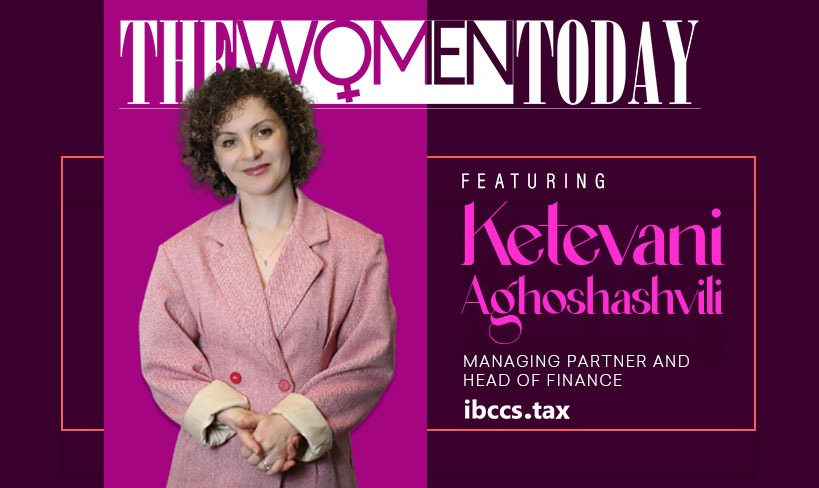
Ketevani Aghoshashvili is a finance, tax and international business expert whose career spans public-sector tax administration, private-sector financial leadership, business advisory and international relations. As Managing Partner and Head of Finance and Tax at IBCCS TAX Georgia, she combines financial expertise, legal knowledge and an international perspective to help businesses navigate the complexities of the Georgian market. With more than a decade of professional experience, Ketevani has worked across tax law, financial planning, regulatory compliance, investor relations, financial management and international business. Her journey from the Georgian Revenue Service to senior private-sector leadership offers valuable insight into what it takes for women to build influence in highly technical and responsibility-driven fields.
A Journey across Public and Private Finance
We started the interview by asking, “Ketevani, your career has taken you from public-sector tax administration to senior private-sector financial leadership. Looking back, how would you describe your professional journey?”
Ketevani Aghoshashvili replied, “My career has developed step by step, and each stage has given me a different perspective on business, finance and taxation.
I began in the public sector at the Georgian Revenue Service, working in areas connected with taxation and tax disputes. Over time, I became involved in broader professional areas, including VAT reforms, legislative development and international representation. This experience gave me a deep understanding of how tax systems work beyond individual transactions or companies. I could see how tax policy, legislation and administration influence the wider business environment.
The move to the private sector was a very important transition for me. As a financial manager and later as a Chief Financial Officer, I experienced the business side of finance directly. I was responsible for budgeting, financial planning, analysis, audits and banking relationships. I began to see more clearly how financial and tax decisions affect daily operations, investment decisions and long-term growth.
Today, as Managing Partner and Head of Finance and Tax at IBCCS TAX Georgia, I bring those experiences together. I understand the regulatory perspective, but I also understand the realities businesses face when they need to grow, manage cash flow, invest and make decisions in changing markets. I believe this combination has shaped the way I work with clients and approach complex business challenges.”
From Public to Private Leadership
The Women Today: What was the biggest shift for you when you moved from the Georgian Revenue Service into private-sector leadership?
Ketevani Aghoshashvili replied, “The biggest shift was moving from understanding the system from an institutional perspective to experiencing its impact directly from inside a business.
In the public sector, the focus is naturally on legislation, administration, consistency and implementation. In the private sector, the same regulatory and tax issues become part of a much broader set of business decisions. A tax obligation may affect cash flow. A financial decision may influence expansion. A regulatory delay may affect a project or investment timeline.
This transition taught me that technical expertise is important, but context is equally important. It is not enough to know the rules. You need to understand how a particular business operates, what its commercial objectives are and what risks it faces.
That experience made me a more practical finance and tax professional. Today, when I look at an issue, I do not see it only as a compliance question. I consider its financial, operational, legal and strategic implications.”
Connecting Law, Tax and Finance
The Women Today: Your career includes experience in tax law, public finance, financial management and international business. How have these different disciplines shaped your professional approach?
Ketevani Aghoshashvili replied, “I consider my career to be interdisciplinary, and that has become one of my greatest professional strengths.
My legal education taught me to think carefully about legislation, interpretation and risk. My work in taxation gave me a technical understanding of the relationship between businesses and the tax system. My education in public finance added a broader economic and policy perspective. Then, my experience in the private sector taught me how all of this affects real business decisions.
When these disciplines come together, you begin to see the full picture.
A business problem may appear to be a tax issue, but it could also involve corporate structure, financial planning, investment strategy or regulatory risk. My approach is therefore not to look at issues in isolation.
This is particularly important for international companies. They often have strong global structures and established standards, but every market has its own legal, financial and operational realities. The challenge is to connect international expectations with what works in practice locally.”
What Leadership Means
The Women Today: As a woman who has built a career in highly technical and responsibility-driven fields, what has leadership meant to you personally?
Ketevani Aghoshashvili replied, “For me, leadership has never been only about a job title. It has been about taking responsibility for decisions, continuing to develop professionally and being trusted by the people around you.
When you work in tax and finance, your work can have significant consequences. People depend on your judgment. Businesses make decisions based on financial information and professional advice. That naturally teaches you to become more careful, accountable and disciplined.
As a woman, I have also learned the importance of developing confidence through competence. In technical fields, knowledge is essential, but eventually you also need to be willing to express your professional opinion, make decisions and take responsibility for them.
I do not believe leadership develops at one particular moment. My leadership journey was built through different roles, challenging situations and increasing responsibilities. Every experience-from public service to private-sector finance and now to managing a professional practice-has shaped my understanding of leadership.”
Women in Finance and Business
The Women Today: What do you think women can bring to leadership in finance, tax and international business?
Ketevani Aghoshashvili replied, “I think the most important thing is not to assume that there is one particular leadership style for women or for men. Every strong professional brings different experiences and perspectives.
What is important is that more women are taking leadership positions in areas that were traditionally seen as highly technical or male-dominated. This creates a wider range of perspectives in decision-making.
For me personally, strong leadership involves both analytical thinking and the ability to work effectively with people. Finance and taxation may be technical disciplines, but every decision ultimately affects people, organizations and relationships.
I would like to see more women recognize that technical expertise and leadership are not separate career paths. A person can be deeply knowledgeable in a specialized field and still develop into a strong business leader.”
Lessons from Both Sides of Business
The Women Today: You have worked in both the public and private sectors. What is one important insight about business that you could only have gained by experiencing both?
Ketevani Aghoshashvili replied, “I learned that the same issue can look very different depending on where you stand.
From a regulatory perspective, a rule may be clear and logically designed. From the perspective of a business, however, implementing that rule may require changes to processes, systems, staffing or financial planning.
Experiencing both sides taught me the importance of practical communication. There needs to be an understanding between policy and business.
It also taught me that businesses should not view tax authorities or regulation only as obstacles. A well-functioning tax and regulatory environment is an important part of a stable business ecosystem. At the same time, institutions benefit from understanding the practical realities businesses face.
My experience across both sectors has helped me become a bridge between these perspectives.”
Why Georgia Attracts International Business
The Women Today: Georgia is increasingly attracting the attention of international businesses. What makes the country an interesting market for investors and companies?
Ketevani Aghoshashvili replied, “Georgia has several characteristics that make it attractive to international businesses. Its strategic location between Europe and Asia gives it an important role in regional trade and connectivity. The country also offers a relatively flexible business environment, a competitive tax framework, growing international market connectivity, and potential for companies considering Georgia as a base for regional operations.
However, I always encourage investors to look beyond general descriptions of a market. Georgia’s advantages need to be assessed in the context of the specific industry, business model and investment objectives. For one company, location and access to regional markets may be the main advantage; for another, the tax framework, operating environment or opportunity to establish regional functions may be more relevant.
The key is to conduct proper analysis rather than assume that the same market-entry strategy or tax model will work for every company.”
Entering the Georgian Market
The Women Today: What practical advice would you give an international company before it starts operating in Georgia?
Ketevani Aghoshashvili replied, “My first recommendation would be to begin with a structured market-entry review. A company should understand its intended business model and then assess the legal structure, tax implications, accounting requirements, employment considerations, banking arrangements and ongoing compliance responsibilities.
One common mistake I see is businesses selecting a tax regime or business structure based on their own assumptions or on general, sometimes unverified, information found online, without first assessing whether that model is actually suitable for their specific activities and circumstances.
A tax regime that may appear attractive in general is not necessarily the right solution for every business. The appropriate structure should be determined based on the company’s actual activities, sources of income, operational model, cross-border transactions, and applicable eligibility and compliance requirements. Making this assessment at the beginning can help businesses avoid incorrect structuring, unexpected tax exposure, compliance issues or the need to restructure later.
It is also important to understand how the Georgian operation will interact with the wider international group. Questions around contracts, cross-border transactions, management responsibilities and financial reporting should be considered early.
I would also encourage companies to build a strong relationship with reliable local professionals. The goal is not simply to outsource compliance but to develop a clear understanding of the local environment.
Good preparation does not eliminate every challenge, but it gives a company a much stronger foundation for sustainable growth.”
International Expertise
The Women Today: How does your work at IBCCS TAX Georgia connect with your broader personal expertise in international business?
Ketevani Aghoshashvili replied, “My work at IBCCS TAX Georgia allows me to apply the different experiences I have developed throughout my career. Many of the businesses we work with need more than a narrow answer to a single tax question. They may be expanding, entering a new market, restructuring operations or managing international relationships. These situations require an understanding of the bigger picture.
As Managing Partner and Head of Finance and Tax, I work with a team that supports clients across financial, tax and regulatory matters. My role naturally involves bringing together my experience in taxation, finance, law and international business.
What is most important to me is that clients receive advice that is technically strong but also practical. Businesses need solutions that work in the real world.”
Turning Business Challenges into Opportunities
The Women Today: Can you share an example where your team’s advisory work had a significant impact on a client’s business in Georgia?
Ketevani Aghoshashvili replied, “One case that particularly stands out involved an international company that was already operating in Georgia but was considering leaving the market. The business was operating at a loss, and its existing business model was not fully aligned with the applicable local regulatory requirements.
The company initially approached us for support in connection with exiting Georgia. However, before treating market exit as the only solution, our team conducted a detailed assessment of the company’s operations, business model, financial situation, tax position and regulatory requirements.
Based on that analysis, we identified that the underlying issue was not necessarily the Georgian market itself, but the way the company’s business model and tax approach had been structured for its local operations. We proposed changes to the business model and planned a more appropriate tax approach aligned with the company’s actual activities and the applicable requirements in Georgia.
The company implemented the recommended changes and, instead of leaving the country, continued its operations in Georgia. Today, the business is operating successfully and has moved into profitability.
For me, this case is a strong example of why tax and financial advisory should not be viewed only as a compliance function. Sometimes, understanding the business model behind the numbers can completely change the strategic decision a company is about to make. The right solution is not always to exit a market; sometimes it is to redesign the way the business operates so that it becomes both compliant and commercially sustainable.”
Beyond Traditional Budgeting
The Women Today: Financial planning is one of your core areas of expertise. In your view, what separates strong financial planning from simply preparing a budget?
Ketevani Aghoshashvili replied, “A budget is an important tool, but financial planning is a broader process.
Strong financial planning connects numbers with decisions. It helps a business understand where it is today, where it wants to go and what financial resources and risks will affect that journey. This includes cash flow, investment priorities, tax obligations, financing, cost structures and potential changes in the market. It also requires regular review because a plan that is not updated can quickly become disconnected from reality.
I believe one of the biggest mistakes companies make is treating financial planning as an annual exercise. The strongest organizations use financial information continuously to support decision-making.”
Lessons from Entrepreneurship
The Women Today: You are also the Founder of SmartCLM. What has founding a business added to your understanding of leadership?
Ketevani Aghoshashvili replied, “Founding a business gives you another perspective because it places you directly in the position of making decisions, creating something new and taking responsibility for the direction it takes.
It reinforces the importance of adaptability and long-term thinking. As a founder, you need to be able to identify opportunities while also managing uncertainty.
My background in finance and tax is useful because I naturally think about structure, risk and planning. But entrepreneurship also reminds you that not every important decision can be made only through numbers. Vision, timing and understanding people are equally important. It has added another dimension to my understanding of business leadership.”
The Biggest Leadership Lesson
The Women Today: What has been the most important lesson in your own leadership journey so far?
Ketevani Aghoshashvili replied, “One of the most important lessons has been that professional growth requires you to move beyond your comfort zone.
Each major stage of my career involved a new challenge. Moving from public service to the private sector was a major transition. Taking on senior financial responsibilities required me to make more complex decisions. Moving into partnership and broader leadership required me to think not only about my own work but also about teams, clients and long-term strategy.
I have learned that you do not need to know everything before taking the next step. What matters is having a strong foundation, being willing to learn and taking responsibility seriously.”
The Legacy Ketevani Wants to Build
Lastly we asked, “When people think of Ketevani Aghoshashvili as a professional and business leader, what would you like them to associate with your name?”
“I would like to be known as a professional who combines expertise with integrity and understands both the technical and human sides of business.
My career has taken me through public service, taxation, finance, international business and entrepreneurship. Each stage has taught me something different, but the common principle has always been the importance of knowledge, responsibility and continuous development.
I hope people see me as someone who can help connect different perspectives: public and private sectors, law and business, international expectations and local realities.
And if my journey also encourages more women to pursue ambitious careers in finance, taxation and business leadership, that would be something I would be very proud of.” Ketevani Aghoshashvili concluded
Connect with Ketevani Aghoshashvili on LinkedIn
For more information visit IBCCS TAX Georgia
Also Read:-
Jasmina Hudić: Making Privacy and Compliance Work
Dr. Henrietta Newton Martin: Law, AI, Governance & Purpose
Dolce Condé: Why Employee Health Drives Business Strategy